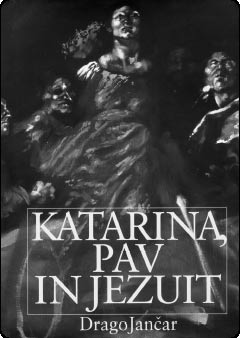
Drago Jančar
Katarina, pav in jezuit
Slovenska matica 2000
The Best Novel of The Year ("Kresnik") Award
Drago Jančar (b. 1948) is perhaps the most extensively translated Slovenian writer, playwright and essayist, and the one that has received the greatest number of foreign awards; he is also a former dissident and political prisoner because of his "anti-socialist propaganda". Repression is Jančar's recurrent literary theme: Repression by the powers that be as well as the existential repression felt by the searching, unfulfilled person. Both kinds are dealt with in Jančar's short stories (anthological selection Ultima creatura, 1995), and numerous plays and novels (among them: Galley-slave, 1978; Northern Lights, 1984; Mocking Desire, 1993; Ringing in the Head, 1998; all four have been translated into German, and the last one has been made into a film). His heroes are driven from place to place by insatiable desires, while the empty heavens, incomprehensible to man, stretch above them. Despite that, Jančar's heroes make personal or social commitments: By consciously rebelling, by yearning as searching travelers, or with their sheer tenacity. In Jančar's latest (2000) historical novel (set in 1756) Katarina, the Peacock and the Jesuit, the pilgrim Katarina seeks Love. The pilgrim Simon, a Jesuit, seeks lost faith. A lieutenant, the "Peacock", seeks glory in battle. Which of them will - at least to some degree - realize their aspiration?
Vanesa Matajc
Vanesa Matajc is the Winner of the Best Young Critic ("Stritar")
Award.
Translated by Tamara Soban.
Published for the Slovenian presentation at the Frankfurt Book
Fair,
October 2002, by the Center for Slovenian Literature.
Catherine, Peacock and Jesuit (excerpt)
In Santa Ana there was no rebellion; Father Simon Lovrenc set out with some thirty Guaranís, who took along their families, because they were very attached to them and felt they alone could protect them. So, with thirty Guaranís and two Belgian Fathers he was riding to a distant estancia, and there his mission ended in an instant, with a blow on the head, with legs tied, with a thought of Father Superior Herver, who'd stayed back in Santa Ana, a bottle of yerba mate in hand. The estancia, where they spent the night after a two days' ride, was at dawn surrounded by the bandeiranti from Săo Paolo. They were so close that one could hear the neighing of the horses, loud conversation, see the weapons glittering in the morning sun. A messenger arrived with a request that the estancia should surrender; all those unarmed would be spared, the fathers would be sent to Săo Paolo, and from there to Europe on board the first ship. Corregidor Hernandez Nbiarú, who was also unwilling to leave his family behind at the pueblo, suggested they should surrender under the condition that the soldiers let three Guaranís and a Belgian Father return with the women and children; they were willing to lay down their arms under this condition, or else would fight as Nicolas Neenguiro decided, and along with him all the Indians and Jesuits in Concepcíon and San Miguel; with their children and fathers they would go to heaven, to the Land Without Evil. When the messenger returned to his men, the congregation could hear short laughter, orders, rattling of weapons, stamping of hooves; they attacked at once. And the last thing Father Simon saw before his legs were tied and he was shoved onto the cart was little Teresa. The Portuguese rider picked the child from the ground in gallop and rose her, kicking, on the horse. Deo gratias, she shouted in terror, or perhaps in sudden revelation, or perhaps because she thought those were the Portuguese words the horrible man with a knife would understand, Gratias tibi, Domine, the rider for a moment held the knife up in the air when he heard her, then he laughed, Joăo, he shouted to the man setting the wooden hut to fire, Joăo, have you heard? The little beast speaks Latin, she thanks you, said Joăo and laughed; and the other slit her throat, this was the last thing Father Simon saw, he can still see it: little Teresa, whom the Portuguese rider pulled up in the saddle, slit her throat with a brisk cut, and threw her off like a piece of cloth, like a carcass, then rode on. Thus died this Lamb of God, the beautiful and bright girl, who had shortly before learnt to say with a pretty voice Deo gratias, gratias tibi, Domine ...by the way, during the ride with an armed cavalier. Ecce Agnus Dei, qui tollis peccata mundi.
Translated by Lili Potpara