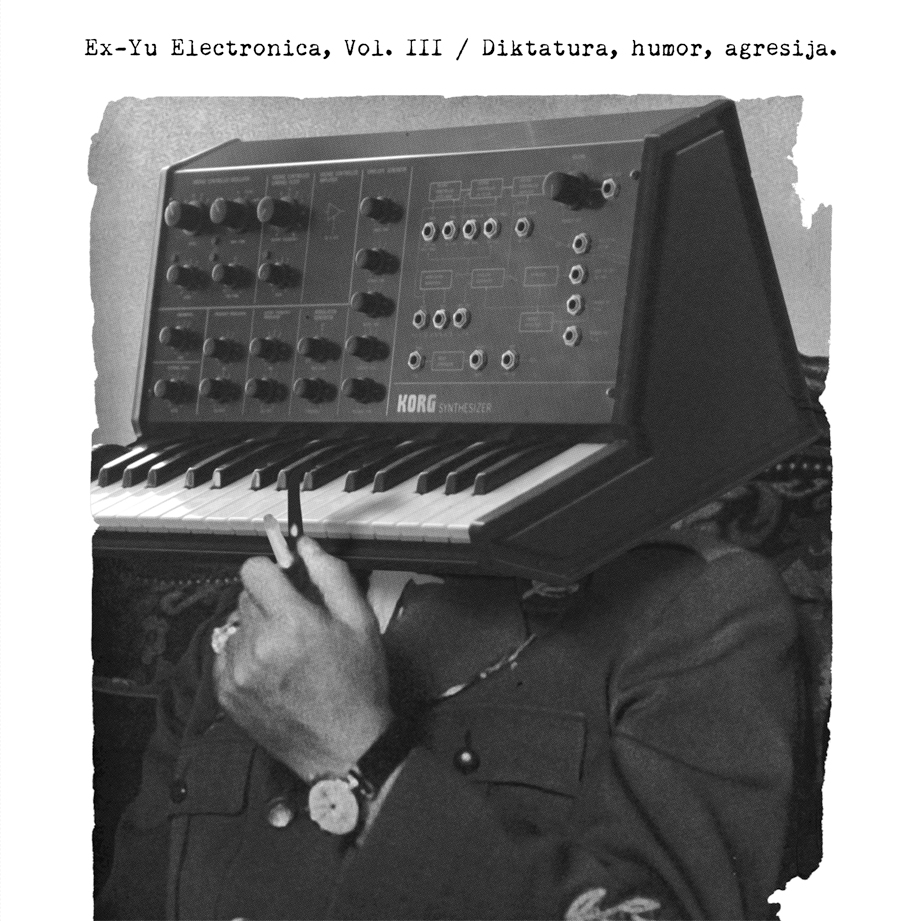
EX YU ELECTRONICA VOL III: Diktatura, Humor Agresija
Monofonika / Subkulturni azil ; MFLP 005 / FREELP 021 / 2012
Vsebina:
Stran A:
Strukturne ptice – Bojom flora
Aporea – Mir prezhde rozhdestva
Rex Ilusivii – In the Mooncage IV.
Stran B:
Mario Marzidovšek – Bio-Industrial 4 (MP3, MP3 zip, WAV)
Strukturne ptice – Zbog zvuka i pobudjivanja
Jozo oko gospe – Reci Omm
Imitacija života – Headline
Smiles of Fortune – Geisha Tit
Sound And Incitement| Compiler’s Notes on Dictatorship, Humour and Aggression
One of the most quoted Josip Broz Tito sentences about movements in history becoming reactionary, while attempting to perpetuate itself, was not only a purely philosophical statement of a cigar & leisure loving leader. What the beloved Yugoslav lifelong president said was meant to be taken seriously, at least for government institutions of the time. Some artists paid their price in jail-time, some were proclaimed persona non grata, but the majority knew how to milk the snake and not get bitten. Now, when obscure records with Tito speeches are cheap collectibles on flea markets, making camp lovers happy and hipsters even cooler, one might disregard those thoughts as a useless historical relic. However, that relic in form of the time passed caused some of the most valuable movements in the history of ex-Yugoslav music, marking the era important and inspiring. Some of the musicians included in this compilation only started to make their sign on the flowering scene, some were already established names in a deep level of the underground, which was in the shape of self-released cassettes even more radical than record industry’s alternative darlings. Reactionary? Only in terms of parody, like Laibach used to do.
The first two instalments of Ex Yu Electronica series focused on more experimental & industrial pieces, this one highlights the ‘electronic’ part of the title. One must know that Yugoslavia was not like other communist-bloc countries, where it was forbidden to import records, synthesizers and similar equipment or the borders being completely closed. During 1980’s, when most of the music on this LP happens, there was a steady flow of new music. The biggest labels like Jugoton in Zagreb, PGP RTB in Belgrade or ZKP RTLJ in Ljubljana had licensing deals with foreign labels, so the most important albums were in the shops, maybe not in the time of their exact international release, but they were present. Some of the music theorists in ex-Yugoslavia marked the starting points of home grown movements calculating the time needed for records to arrive – synth-pop took a year later than Europe, new wave was faster, punk also. And industrial? Experimental? They probably would have not have happened if there was no cassette scene. That medium was beneficial to all the genres – it was faster, easy to copy, less expensive to produce, cheaper to sell and it did not need an institutional background or big money behind it. The cassettes were a much needed fix to filtered selections of producers and editors, like the digital medium of today is to the overgrown concepts of old-fashioned major labels.
One step further (not back!) is limiting this compilation only on vinyl. You might agree or not, but the medium itself will physically make you listen to it more carefully. You’ll find here, firstly, unreleased tracks from
STRUKTURNE PTICE art group of musicians, performance artists and theatre lovers based in Rijeka (Croatia). The core member was
Damir Martinović Mrle, who calls Strukturne ptice
Let 1, in relation to his hugely popular group
Let 3. Some of the aesthetics known for
Let 3 trace back to this group and of course to
Let 2, which was a phase between. Most extreme and radical, musically and performance wise was indeed Strukturne ptice, who had been published later on ‘Rijeka-Paris-Texas’ and ‘Riječki novi val’ compilations, but with guitar-oriented music. The songs included here date in early 1984, paint Strukturne ptice in completely different light - more experimental, more electronic and even cold-wave thanks to the vocals of Tatjana Simić who later played drums in all-female pop darlings
Cacadou Look. An effort was made to make it to a full album, music magazine MOL from 1985 even announced it, but it was never published. All that was left was few tracks on a tape, produced by Aldo Ivančić from Borghesia. Damir Martinović Mrle is one of the most important musicians / actors / performers / movers on the famous
Rijeka scene. He was the part of Strukturne ptice, Let 2, Termiti, Beta Centaury and is the founding member of Let 3. He is recently involved in the organization of Hartera Festival
[1].
Other musician featured on this compilation with two tracks is famed Mitar Subotić, known as Suba or REX ILUSIVII. ‘The King Of Illusions’ was born in Novi Sad (Serbia) in 1961 and tragically died in Sao Paolo (Brazil) in 1999. He was a pioneer of electronic music in former Yugoslavia, since he mixed and produced a number of celebrated albums of Yugoslav New Wave acts such as Ekatarina Velika and Haustor in the 1980s. ‘In The Mooncage’ series, his fusion of electronic music and Yugoslav folk tunes (sampled here by Milan Mladenović), was awarded by UNESCO, which included a three-month scholarship to research Afro-Brazilian rhythms in Brazil. Falling in love with the country and its music, he emigrated to Sao Paulo in the 1990s. The two tracks presented here are alternate recordings from Mitar, made in Radio Novi Sad Studio in 1988. The later part “Outro” is edited from that special tape, when he directs the listener to turn the cassette back. All the copies Mitar Subotić used to send to the journalists by himself. ‘In The Mooncage’ was never released in Yugoslavia, although it was performed on public squares and on the radio. The work of Mitar Subotić remains to be discovered as his large output was also in stage, radio, theatre and television.
Continuing the theme of electroacoustics and traditional, folk influences is art-collective
APOREA from Macedonia.
Goran Trajkoski (Padot na Vizantija, Mizar, Anastasia)and
Zoran Spasovski (Mizar, Anastasia) arethe founding members who released only one official album ‘Na riekah vaviloskih’ on a self-published cassette. The cover of the tape was art in itself made by hand-painting and engraving. Nenad Vujić writes about it on his famous ‘Hogon’s Industrial Guide’: “
Aporea or Apokrifna Realnost from Skopje is a multimedia project whose musical output could easily fit the best tradition of any ritual industrial bands that rose in mid and late 80es era. For
Aporea the starting ground is active exploration of the complex relationships with their own cultural and spiritual heritage through a specific postmodern, westernized frame of work - art exhibitions, music distributing, subcultural activity, as means of reconciling their people with the new reality they were heading to, but in the same time - finding an adequate modus viviendi for an individual's own spiritual continuance within the sociological context of postmodern Europe
[2].”
If
Aporea was preparing it’s listeners for a New Europe,
MARIO MARZIDOVŠEK from Slovenska Bistrica (Slovenia) wasalready experiencing it. Lately known thanks to other Subkulturni Azil releases,
Marzidovšek was the scene himself, artistical entity of huge importance and quality which included industrial music, the first privately owned label in Yugoslavia, mail-art, concerts, events and performances. From 1984 to 1988 he published more than 50 cassette releases. “When he started to explore art and music,
Mario Marzidovšek was employed in a chemical factory. He was also fascinated with industry in the town of Maribor, one of the major industrial towns in the former Yugoslavia. In the late phase of his work, his music became much closer to other European post-industrial works with apparent dance connotations. Mario Marzidovšek has named that phase as "more melted industrial sampling tech". It is not a coincidence that his most mature work was a cassette entitled ‘Marburg’ (a German name for Maribor). On that tape he successfully combined industrial electronic music with occasional techno or electro funk elements. Scott Lewis wrote about that tape in Option (August 1987): "Retained industrial electronics with simple rhythms in the center. It's pretty good.”
[3]
And now a true undiscovered pearl of the Yugoslav art scene.
IMITACIJA ŽIVOTA were
Željko Serdarević (music) and
Darko Fritz (slide projections), art group from Zagreb founded in 1987 and ended in pre-announced 3 year lasting period in 1990. The group manifesto rejected usual stage standards and techniques of performing, so the output was series of mixed-media projects involving music, design and performance. Sadly, the group’s output never received deserved musical acknowledgement, but were warmly received among art historians and design magazines. As
Željko Serdarević now famed Croatian designer and publisher remembers, “they probably thought that our music is sampled from elsewhere”. In his essay ‘Regresija’ Serdarević explains methodology of live performing: “We insisted on different performing venues, but the structure of the event was always the same: two protagonists, the Pianist and the Projectionist, waited for the audience with sound and video installations in prepared space. The program started with the gesture of taking off the hand watch, which marked the exit from the real time.”
[4] Imitacija života was musically far ahead of their peers, with Serdarević doing all the composing and playing. Born in Split in 1965, Serdarević played keyboards in many regional New Wave groups like Mea Cvlpa, Zračna opasnost, Abortus and Tužne uši. Between 1982 and 1984 he was the front-man of the Vojnici olovnih nogu.
Imitacija života performed live in places like cinemas, theatres, galleries and even military institutions: Kino August Cesarec, Puppet Theatre, Galerija SC (1988); Dom JNA, Technical museum (1989) and Kino SKUC (1990). All recordings are part of the ‘Krici i šaputanja’ cassette series.
What was Jozo doing with the lady? Or was it Our Lady? That question bothered many Ex Yu music researchers, who stumbled on obscure compilation called ‘101 otkucaj u ritmu srca’, released by ZKP RTVLJ in 1988. Stuttering beats of the song ‘Knock On The Heaven's Door’ crossed over to industrial/EBM reign, but were simply too complex to categorize. JOZO OKO GOSPE was Zagreb based project of Vanja Spirin and late Marko Tanhofer. The group was famed after one promotional concert in Kulušić club, where they played nothing and used the occasion to have fun with the audience. Later in the music press the show was receiving good reviews as “the ultimate rock performance”. Spirin used to play in bands like Teška zemlja, Yo-Yo, Stela, Rehabilitation, Kama, Swing Again, Taras žuljba and now d'Bestest.He is also book author, copywriter and screenwriter. The song included on this LP is a demo featured on ‘041 Compilation’ by Siniša Bizović and his The Institution programme.
Last but not the least is Robert Hrušovar, Croatian musician of Slovenian roots who now lives in Sweden. Under the name SMILES OF FORTUNE (1984-1987), Hrušovar recorded his first synth outings, later going into much aggressive music with his band Blood-Feud, releasing CD ‘Genocide’ for Voodoo Records in 1993. Lately Hrušovar is back to his electronic roots: his project Positive Contact was founded in 2007, then follows much more successful Hatbrott in 2008. With the core, minimal sound of electronic body music Hatbrott now publishes for cult German EBM label Electric Tremor Dessau. Also performs live on festivals like Familientreffen and Bodytåget. He keeps singing in Croatian and is still media reclusive.
Željko Luketić
Chief Editor And Researcher
Zagreb
November 2012.
Project Author.......................Dušan Hedl
Chief Editor And Researcher...Željko Luketić
Liner Notes...........................Željko Luketić
Design..................................Nieuw NDG
Copyediting...........................Rick Klaus Theis
Mastering..............................Stojan Kralj
Audio Digitization...................Višeslav Laboš, Igor Mihovilović, Robert Hrušovar
Administration.......................Peter Dobaj, Tatjana-Tanja Cvitko, Branko Hedl
The music presented was transferred from audio cassettes. Every effort was made to ensure quality sound while keeping the original audio parameters as much as possible.
A big THANK YOU goes to all authors and friends who made this compilation possible: Dubravko Jagatić, Damir Martinović Mrle, Željko Serdarević, Goran Trajkoski, Ruža Subotić, Robert Hrušovar, Vanja Spirin, Ivan Antunović, Leri Ahel, Dušan Hedl, Peter Dobaj, Tatjana-Tanja Cvitko, Stojan Kralj, Goran Jemrić, Marko Pelaić, Igor Mihovilović, Višeslav Laboš, Nenad Vujić & Branislav Nikolić.
Dušan Hedl was born in 1961 in Maribor, where he finished high school and college (as an electric technician), and graduated business school in 2006 on the topic ‘Enterprise in culture’. Since 1977 he has worked intensely in the fields of culture, media, art - and cultural - enterprise as a musical (co)author and cultural-media manager. In Maribor he has worked on important functions in all the local institutions connected with youth, students, alternative culture, including Kmečke in rockodelske novice, Katedra, Mariborski radio Študent, Gustav, MKC Maribor. He was a founder of the first Slovene independent alternative art gallery (Galeria 88), the musical label Front rock, the book collection Frontier and the institute for artistic production and publishing Subkulturni azil. In the latter, he is exercising new methods of cultural enterprise. He is the soul, heart and engine of a larger number of cultural projects (Akord festival, No Border Jam, Rokerji pojejo pesnike, etc.). Most of all it would be impossible to imagine the activity and creativity of the punk group Center for dehumanizacijo (CZD) and punk choir Punkappella without him.
Željko Luketić was born in 1972 in Zagreb. He studied journalism on Zagreb University and graduated public relations and marketing on Zagreb based Faculty of Economics. Since 1993 writes film and music reviews for Heroina Nova, Kinoteka, Hrvatski filmski ljetopis, Hollywood and many other magazines. Works for HRT (Croatian Television) since 1998 covering cult films while organizing live cinema screenings at Mama club Zagreb. The first Croatian screenings of Alejandro Jodorowsky, John Waters and similar cult directors were part of his ‘Borderline Cinema’ evenings. Since 1995 works as a film critic and editor at Radio 101, contributing to daily culture broadcasts and news program. In 2003 he starts ‘Borderline Music’ show, weekly night music sessions focused on experimental, rare and weird music. In 2010 he left Radio 101 and the show continued on Elektrana Radio, Exit festival’s official broadcasting unit. Now works on anthology of Ex Yu electronic music and is in pre-production of the film ‘Primitivni ples’, a documentary on the same topic. Continues to write about film in ‘Filmonaut’ magazine where he has special column called ‘Skeletons From The Closet’ about the lesser known and bizarre cinema. Occasionally DJs and creates music under Konrad Medvedov moniker. Member of Croatian Society Of Film Critics.
STRUKTURNE PTICE
Bojom flora
Arranged and Written by: Damir Martinović Mrle
Lyrics: Damir Martinović Mrle
Vocals: Tatjana Simić
Keyboards: Josip Krošnjak Pepi
Tape Manipulation: Damir Martinović Mrle
Drums: Berislav Dumenčić Kiko
Produced by: Aldo Ivančić
Recorded on March 13th, 1984. at FV, Ljubljana.
Length: 8’08’’
Previously unreleased.
APOREA
Mir prezhde rozhdestva
Arranged by: Goran Trajkoski, Zoran Spasovski
Written by: Goran Trajkoski, Zoran Spasovski
Lyrics: Traditional
Vibraphone, Hand-bells, Flutes and Prepared Gramophone: Goran Trajkoski, Zoran Spasovski
Produced by: Aporea
Recorded on a 4-track tape recorder at home studio in Macedonia, 1986.
Length: 4’00’’
Released on ‘Na riekah vavilonskih’ self-published cassette.
REX ILUSIVII
In The Mooncage IV
Arranged and Written by: Mitar Subotić
Lyrics: Traditional
Vocal Samples: Milan Mladenović, Katalin Ladik
Keyboards (Emulator): Mitar Subotić
Keyboards (Synth): Aleksandar Dujin
Guitar: Theodore Yanni
Produced by: Mitar Subotić, Theodore Yanni
Sound Engineer: Jan Šaš
Recorded at Studio 1, Radio Novi Sad, April 2nd 1988.
Length: 7’48’’
Previously unreleased.
MARIO MARZIDOVŠEK
Bio-industrial 4
Arranged, Played and Written by: Mario Marzidovšek
Produced by: Mario Marzidovšek
Part of ‘Marburg’ tape sessions, 1986.
Length: 2’30’’
Published by: Marzidovshekminimalaboratorium (MML)
STRUKTURNE PTICE
Zbog zvuka i pobuđivanja
Arranged and Written by: Damir Martinović Mrle
Lyrics: Damir Martinović Mrle
Vocals: Tatjana Simić
Keyboards: Josip Krošnjak Pepi
Produced by: Aldo Ivančić
Recorded on March 13th, 1984. at FV, Ljubljana.
Length: 4’48’’
Previously unreleased.
JOZO OKO GOSPE
Reci om
Arranged and Written by: Marko Tanhofer, Vanja Spirin
Lyrics and Vocals: Vanja Spirin
Keyboards (Roland Juno 6, Juno 60): Bojan Goričan
Bass-guitar, Programming: Vanja Spirin
Amiga Programming: Marko Tanhofer
Produced by: Ranko Tomašić
Recorded at Art Studio Trnsko, Zagreb, 1989.
Length: 3’57’’
IMITACIJA ŽIVOTA
Headline
Arranged and Written by: Željko Serdarević
Keyboards, Drum-machines (Roland Juno 6, Roland D20, Casio RZ-1): Željko Serdarević
Produced by: Željko Serdarević
Recorded on 4-track Tascam tape recorder, Zagreb, 1989.
Part of ‘Krici i šaputanja’ cassette series.
Length: 4’20’’
Previously unreleased.
SMILES OF FORTUNE
Geisha Tit
Arranged and Written by: Robert Hrušovar
Keyboards (Roland MC202, Roland TR707, Korg MS10): Conny Karlsson, Andreas Hrušovar, Robert Hrušovar
Programming, Effects: Robert Hrušovar
Produced by: Robert Hrušovar
Sound Engineer: Hannu Kiviaho
Recorded live on 2-channels, AV-Centralen Eskilstuna, Sweden, 1985.
Length: 3’15’’
Previously unreleased.
REX ILUSIVII
Outro
Voice: Mitar Subotić
Produced by: Mitar Subotić
Recorded at Radio Novi Sad, April 2nd 1988.
Length: 0’04’’
Previously unreleased.
[1] http://www.hartera.com/
[2] http://ahogonsindustrialguide.blogspot.com
[3] Rajko Muršič: On the relationship of Global and Local Music Production: Mario Marzidovšek and his Independent Label MML
[4] http://dizajn-diskurs.tumblr.com/post/34212611733/regresija
Plošča je na voljo v ploščarni SpinVinyl v Ljubljani.